
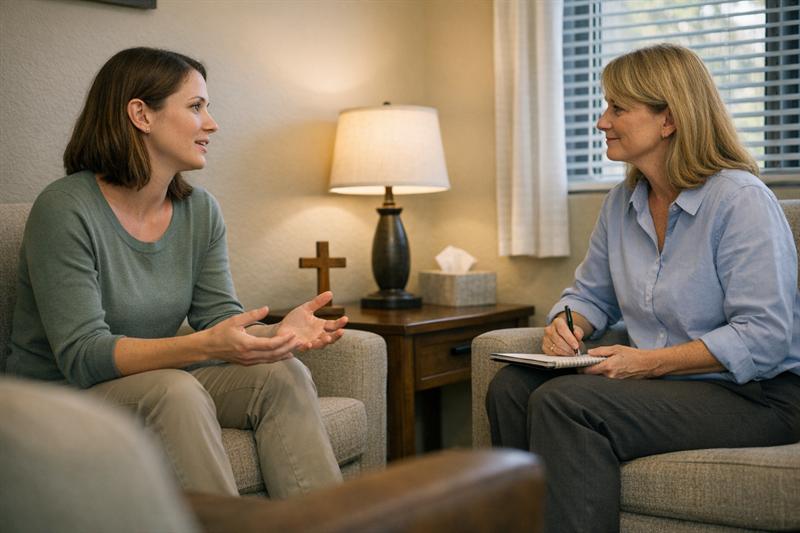
Quick Answer: Your first Christian counseling session is a structured conversation focused on understanding your story, your current challenges, and how your faith may be part of the process. It is not about being judged or having everything figured out. It is about gaining clarity, direction, and starting a guided path forward.
Why the First Christian Counseling Session Can Feel Uncertain
Most people walk into their first session unsure of what will actually happen. That uncertainty can feel even stronger when faith is part of the process. Questions about whether you will be judged, expected to pray, or pushed in a certain direction are common.
Much of that hesitation comes from not knowing what the session will feel like. When the process is unclear, it becomes easy to put off getting support and stay stuck in the same challenges longer than necessary.
Understanding what to expect can take away much of that pressure and replace it with something clearer and more manageable.
Common Questions Before Starting Counseling
- Will I have to talk the whole time?
- Will faith come up right away?
- What if I am not sure where I stand spiritually?
How Christian Counseling May Feel Different
Christian counseling brings together professional counseling with a faith-based perspective. It is not simply giving biblical advice. It follows a structured process designed to understand patterns, address challenges, and support meaningful change over time.
A common concern is that faith will be forced into the session. In a healthy counseling setting, it is typically integrated in a way that respects your comfort level. For a deeper look at this approach, see how faith-based therapy supports mental health.
What Happens Before Your First Appointment
Before the session begins, there is usually a simple intake process. This often includes forms, background information, and a brief overview of what to expect.
This step gives the counselor helpful context so the session can move forward with purpose. When basic information is gathered ahead of time, the first conversation usually feels more focused and productive.
Intake Forms and Background Information
You will typically be asked about your personal history, current concerns, and sometimes your spiritual background. This is not about labeling you. It is about understanding your situation more clearly and identifying where support may be needed.
It also helps bring important connections into view. Stress, relationship strain, and unresolved experiences often affect more than one area of life at a time.
Setting Expectations and Goals
You are not expected to arrive with clear goals. A common mistake is thinking you need to explain everything perfectly. That usually creates more pressure and can make it harder to open up.
The first session is designed to help define direction. Clarity often develops during the conversation, not before it.
Step-by-Step: What Happens During Your First Session
The first session usually follows a clear structure. Knowing what to expect can remove much of the uncertainty that keeps people from getting started.
Getting to Know You and Your Story
The session usually begins with open-ended questions about what brought you in. This helps the counselor understand your situation without making assumptions.
Many people feel pressure to explain things the “right” way. In reality, there is no perfect way to begin. Honest, simple answers are enough to help the conversation move forward.
Discussing Your Current Challenges
You will talk through what is currently difficult. This might include stress, relationship issues, anxiety, grief, or spiritual concerns.
This is often where patterns begin to come into focus. What feels overwhelming on the surface may be connected to deeper habits, pressures, or unresolved experiences. Recognizing those patterns helps shape the next steps.
Exploring Faith and Spiritual Perspective
If you are open to it, your counselor may ask about your faith, beliefs, or spiritual background. This helps connect your current challenges with your values and perspective.
A common misconception is that you need to have strong or consistent faith to benefit from Christian counseling. Many people begin with questions, doubt, or uncertainty, and that can be part of the conversation.
Identifying Initial Goals
By the end of the session, there is usually a general direction. These are not fixed goals. They are starting points that can be adjusted over time.
Having a starting point helps future sessions stay focused and purposeful rather than scattered or surface-level.
How Faith Is Integrated Into the Session
This is one of the most common areas of uncertainty. It is also where many assumptions tend to be inaccurate.
Prayer: When and If It’s Used
Prayer may be included, but it is not required. It is typically offered based on your comfort level and preferences.
Many people worry about this before starting. In practice, it is generally handled collaboratively rather than imposed.
Scripture and Biblical Perspective
Scripture may be used to offer perspective and encouragement. It should not be used to dismiss your experience or oversimplify what you are going through.
The goal is to connect spiritual insight with real-life challenges while still making space for practical support and honest conversation.
Respecting Your Comfort Level
You are not expected to perform spiritually. You are allowed to ask questions, express doubt, and talk through your beliefs honestly.
This is where trust often begins to build. When people feel safe, they tend to engage more openly, which makes the counseling process more meaningful.
What Your Counselor Is (and Isn’t) Doing
Clear expectations make the process easier to engage with. Misunderstanding this part is often where frustration begins.
Listening vs. Diagnosing
The first session is focused on understanding, not rushing to conclusions. A counselor is listening for context, patterns, and the concerns that matter most to you.
A careful, structured approach usually leads to clearer next steps and a better sense of what to address moving forward.
Creating a Safe and Confidential Space
Confidentiality and respect are central to counseling. You are not there to be judged or measured as a person.
When people feel safe, they are more willing to speak honestly. That openness is what helps the process move forward in a meaningful way.
What Happens After the First Session
After the first session, there is usually a clear next step. This may include scheduling additional sessions or outlining a general plan for what to focus on next.
This is where consistency becomes important. One session can bring insight and relief, but lasting growth usually takes ongoing work.
Next Steps and Ongoing Sessions
Sessions are typically scheduled on a regular basis. When appointments are inconsistent, it can be harder to build momentum and work through patterns with clarity.
How Progress Is Typically Approached
Progress is usually gradual and builds over time. It may involve working through emotional patterns, relationship dynamics, and spiritual questions together.
Expectations matter here. When people expect immediate results, they may feel discouraged too quickly. When the process is approached with consistency, progress often becomes easier to recognize.
If you are noticing any of the following, it may be time to take the next step:
- You feel stuck in the same patterns despite trying to change them
- Your stress, anxiety, or relationship challenges are not improving
- You are unsure how your faith connects to what you are going through
- You keep putting this off because you do not know what to expect
When these patterns continue, they can become harder to untangle on your own. A structured counseling process may be a practical next step.
How to Prepare for Your First Christian Counseling Session
Preparation does not need to be complicated. Overthinking this step is common and usually adds unnecessary pressure.
Practical Tips to Feel More Prepared
- Arrive on time and give yourself a few minutes to settle in
- Think about what brought you in, even if it still feels unclear
- Write down questions if that helps you stay focused
What You Don’t Need to Worry About
- Having the perfect words
- Being judged for your thoughts or struggles
- Having everything figured out before you start
Key Takeaways
- The first session is focused on understanding, not solving everything at once
- You are guided through the process, not expected to lead it
- Faith is included in a way that respects your comfort level
- Clarity tends to increase once you understand how the process works
Conclusion
The main barrier is often not the counseling session itself. It is the uncertainty that comes before it. When that uncertainty goes unaddressed, the same patterns can continue and become harder to work through over time.
Taking the first step replaces uncertainty with clarity. ER Counseling Services offers a structured, faith-based approach that helps individuals and couples better understand what is happening and begin moving forward with purpose. If you are ready to move past the hesitation, the next step is to learn how to choose the right Christian counselor and schedule your first session.
FAQ
What happens in your first Christian counseling session?
The first session focuses on understanding your background, current challenges, and initial direction. It usually includes guided questions and a discussion of how faith may be included. This helps you move forward with a clearer understanding of what comes next.
Do you have to pray in Christian counseling?
No, prayer is not required. It may be offered, but it is based on your comfort level. You can communicate your preferences so the session aligns with your needs.
What should I say in my first therapy session?
You can start by sharing what brought you in. The counselor guides the conversation, so you do not need to prepare everything in advance. This allows you to open up at a pace that feels manageable.
How is Christian counseling different from regular therapy?
Christian counseling integrates faith with established counseling methods. It may include spiritual discussion alongside structured therapeutic conversation. The approach is typically adjusted based on your comfort with faith.
How long is a first counseling session?
Many first sessions last around 50 to 60 minutes, though this can vary by practice. That time is usually enough to begin understanding your situation and identifying a starting point. A brief consultation may also help you feel more prepared beforehand.
Do I need to be religious to attend Christian counseling?
No, you do not need to be highly religious. Many people begin with uncertainty or questions about faith. The process is intended to meet you where you are and help you move forward from there.